Reawaken your natural collagen biosynthesis
Your body knows how to make its own collagen. It just needs the right materials.
Collagen is not swallowed ready-made: it is assembled, continuously, by your own cells. Understanding this mechanism means understanding why it slows down with age, and how to support it.

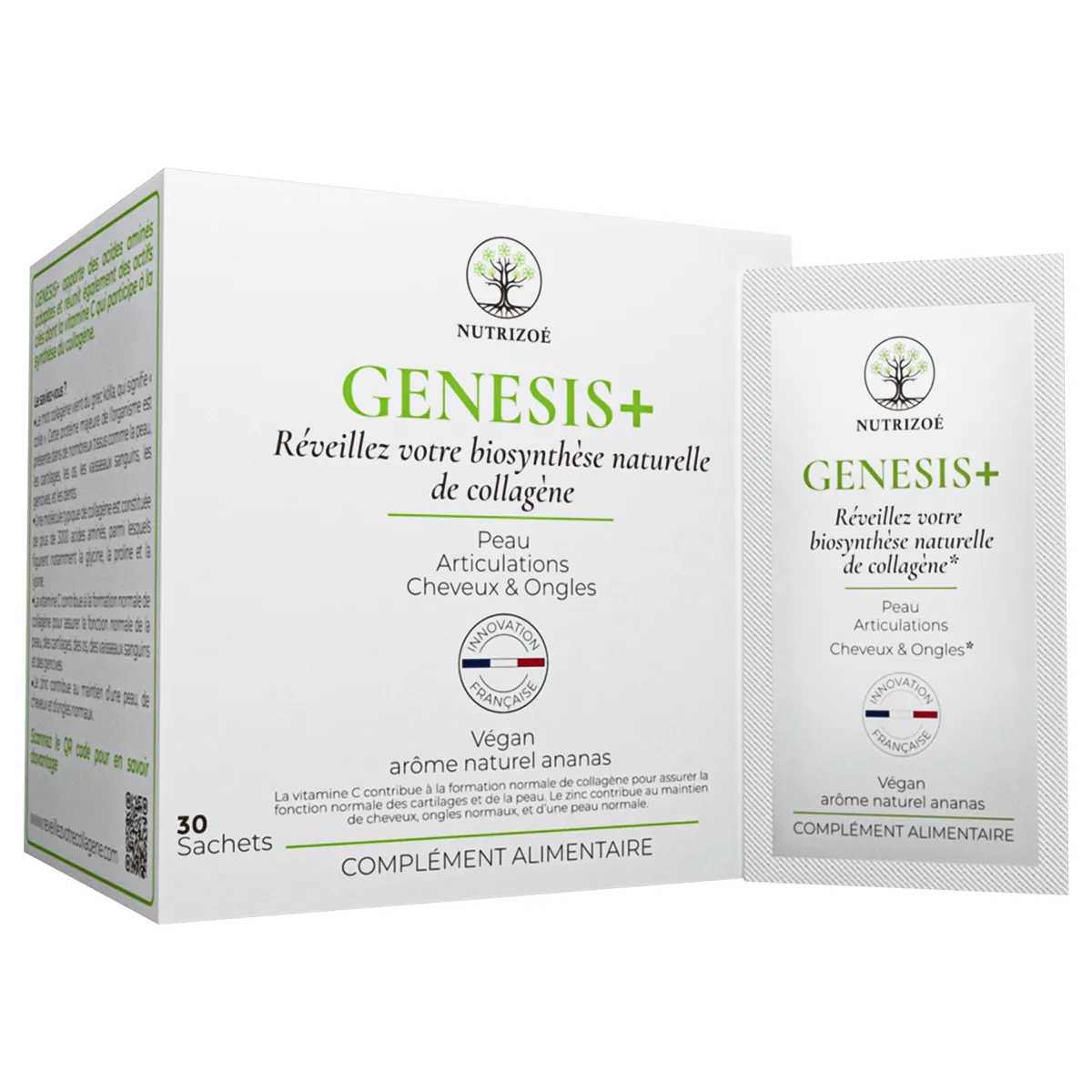

SilverTech Favourite, Product Innovation category
Awarded by the jury on 14 September 2026 at the Palais des Festivals, Cannes.
The SilverEco Awards recognise solutions that improve daily life as we age. The jury selected GENESIS+ for its new approach to collagen.
GENESIS+ is the winner of the “SilverEco 2026 Favourite Solution” award, SilverTech Product Innovation category.The protein that holds everything together
The word collagen comes from the Greek kólla, “glue”. It is the most abundant protein in the body, accounting for around 30% of all our proteins.
It gives skin, cartilage, bones and connective tissues their structure, suppleness and firmness.
There is not just one collagen but several types, made by different cells depending on the tissue.
| Cells | Tissues | Collagen |
|---|---|---|
| Fibroblasts | Skin, ligaments | Types I and III |
| Chondrocytes | Cartilage | Type II |
| Tenocytes | Tendons | Type I |
| Osteoblasts | Bone | Type I |
| Smooth muscle cells | Blood vessels | Type III |
Why does collagen production decline?
The body makes collagen continuously, so production depends directly on the availability of its building blocks: amino acids.
However, from the age of 25 to 30, our body begins to reduce its collagen production, and this decline worsens over time. Our body gradually loses the ability to produce certain amino acids essential to collagen formation. As a result, it can no longer produce enough collagen to meet our needs.
years
The age from which natural collagen production starts to decline.
of our proteins
Collagen is the most abundant protein in the human body.
amino acids
The number of amino acids that make up a single collagen molecule.
An assembly job, brick by brick
Biosynthesis simply means your own cells making collagen. They link thousands of amino acids into long chains, which then wind into a very strong triple helix: the collagen fibre.
With age, it is not the walls that are missing but the bricks: without enough material, production slows down.
Three amino acids recur constantly in this structure, far more than in most proteins:
And vitamin C?
Bricks alone are not enough: you also need the right tool. Vitamin C stabilises the chains by transforming proline and lysine (a step called hydroxylation), which is essential for strong fibres.
That is why vitamin C contributes to normal collagen formation.
Animal collagen or amino acids: the real difference
The body never uses a protein as it is. Whether it is an egg, a steak or collagen, everything is first broken down into amino acids during digestion. Animal collagen that you swallow therefore does not turn into human collagen.
In both cases, your cells make the collagen. What changes is what you give them.
A long detour
- Ready-formed collagen (marine or bovine)
- Digestion, which costs energy
- Amino acids in the animal's proportions
- Biosynthesis
The right bricks, directly
- Targeted amino acids, cofactors and NAG
- Provided as they are, with no protein to digest
- A profile designed for the needs of cells
- Biosynthesis
| Animal collagen | GENESIS+ | |
|---|---|---|
| What is provided | Ready-formed collagen, marine or bovine | Targeted amino acids and cofactors |
| Digestion | Must first be digested to release its amino acids | Amino acids provided as they are |
| Proportions | Inherited from the animal | Designed for the needs of human cells |
| Origin | Animal | 100% vegan |
Give the body the materials, and let it do the rest
Five amino acids accounting for more than two thirds of the building blocks of collagens I, II and III.*
GENESIS+ brings together in a single formula what your cells use to produce collagen: the main building blocks, their cofactors, and what is needed to maintain the surrounding matrix.
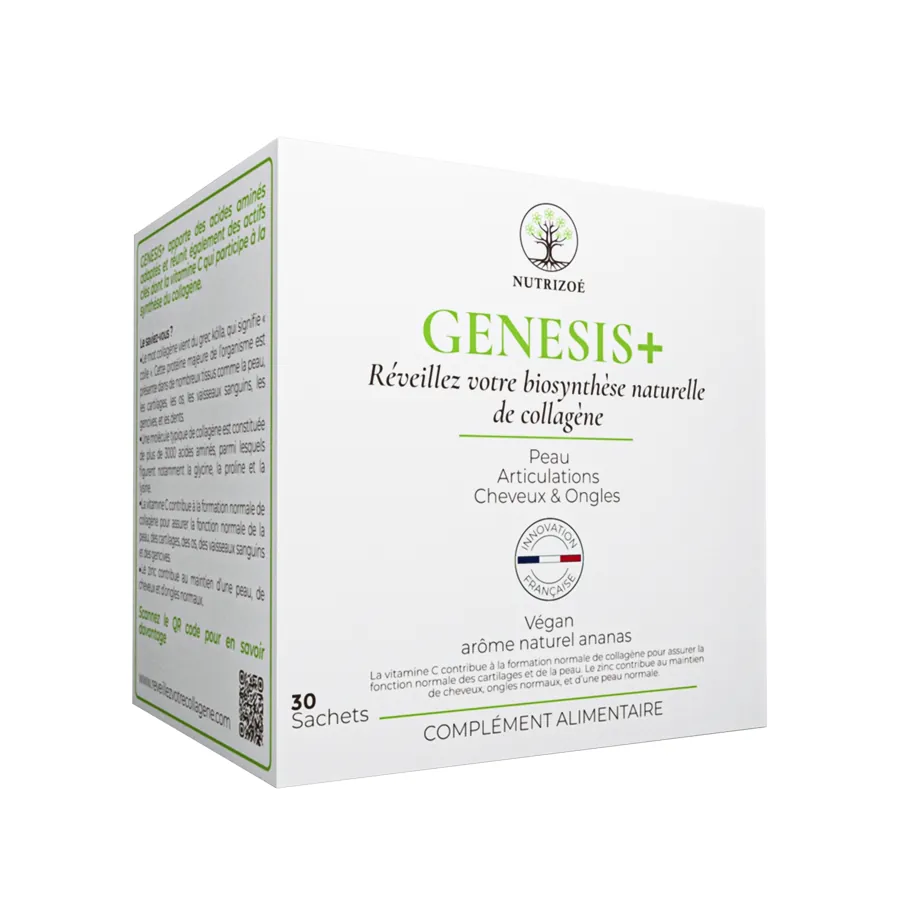
The bricks
Glycine, proline and lysine, the most abundant amino acids in the structure of collagen.
Supporting amino acids
Glutamine and arginine, also present in collagens. Glutamine is also a precursor of proline.
The cofactors
Vitamin C contributes to normal collagen formation; zinc contributes to the maintenance of normal skin, nails and hair.
The matrix
N-acetylglucosamine, a component of the hyaluronic acid found around cells.
*Triple-helix regions, by number of residues; hydroxylated proline and lysine included. Calculated on human reference sequences. Source: UniProt.
Designed to be taken every day, effortlessly
Excellent dilution
Extra-soluble powder: one glass of water (250 ml) and it is ready, with no lumps.
Individual sachets
An exact dose every time, easy to take anywhere.
Natural pineapple flavour
Sweetened with stevia. More flavours coming soon.

Composition
| Per 2 sachets | Amount | RI* |
|---|---|---|
| Glycine | 10 g | – |
| L-proline | 2 g | – |
| L-glutamine | 2 g | – |
| L-arginine | 1 g | – |
| L-lysine | 1 g | – |
| N-acetyl-D-glucosamine | 1 g | – |
| Vitamin C | 500 mg | 625 % |
| Zinc | 15 mg | 150 % |
*RI: reference intake. Ingredients: glycine, L-proline, L-glutamine, L-arginine, L-lysine, vitamin C, zinc, N-acetyl-D-glucosamine, natural pineapple flavouring, stevia-based sweetener, excipients.

A sealed box
The new reinforced box is closed with a tamper-evident seal. When intact, it guarantees the box has never been opened.
Who is GENESIS+ for?
Four groups of adults, women and men, who want to give their body the essential building blocks it needs to make its own collagen.

Women over 40
During perimenopause and menopause, a nutritional approach to skin: providing the body with the building blocks it needs to make its own collagen.

Seniors
To support the body as it ages: vitamin C contributes to normal collagen formation for the normal function of cartilage.

Active men and women
For regular exercisers who put their joints to work: collagen precursors in a vegan formula that fits easily into training.

Adults who care about staying youthful
For those who want to look after their skin, hair and nails over time, without animal collagen.
The formula's recognised functions
Joints
Vitamin C contributes to normal collagen formation for the normal function of cartilage.
Skin
Vitamin C contributes to normal collagen formation for the normal function of skin.
Hair and nails
Zinc contributes to the maintenance of normal hair and nails.
Every day
A course designed to fit into your routine over time.

Perimenopause and menopause: a new stage for the skin
A time of transition
Around the age of fifty, perimenopause and then menopause mark a turning point in women's lives. Many notice that their skin changes.
Collagen production slows down
From the age of 25 to 30, our body starts to reduce its collagen production, and this decline increases over time.
A nutritional approach, without animal collagen
GENESIS+ gives the body the essential building blocks it needs to make its own collagen. Vitamin C contributes to normal collagen formation for the normal function of skin.
Preserving the movements that make independence
A concrete issue in ageing well
Walking, getting up, getting dressed or gardening: these movements give real meaning to mobility and independence.
Supporting tissues play their part
Together with muscles and the nervous system, they take part in everyday movements. Their matrix relies on molecules produced and organised by our cells.
The opportunity of cellular nutrition
Targeted intakes, as part of an approach combining diet, physical activity and health follow-up.

They have adopted GENESIS+
“I loved this course. […] It has become my morning ritual.”
“The taste is very pleasant. […] It's a lovely discovery.”
“[…] There's no bad taste, and I like that.”
“A very good product, natural above all.”
“The product tastes good and is well digested by the body.”
“Very satisfied.”
Reviews published on vitaminec.com by customers who ordered the product (order date verified) and testimonials collected by NutriZoé, published with their authors' consent. All shop reviews, unfiltered, can be read on vitaminec.com. Reviews translated from French.
Your questions about GENESIS+
Is GENESIS+ a collagen?
No. GENESIS+ contains no collagen: it provides the amino acids your cells use to make it, plus vitamin C, which contributes to normal collagen formation.
Why does it not contain marine or bovine collagen?
Because GENESIS+ targets the same biosynthesis by a more direct route. Animal collagen must first be digested to release its amino acids, whose profile depends on the source tissue. GENESIS+ directly provides the targeted amino acids and their cofactors. The formula is also 100% vegan.
Should I combine it with a collagen?
No, that is not necessary. GENESIS+ directly provides the amino acids and vitamin C, which contributes to normal collagen formation.
Is GENESIS+ vegan?
Yes, 100% vegan: no ingredients of animal origin.
What does it taste like?
A natural pineapple flavour, sweetened with stevia. More flavours coming soon.
How do I take GENESIS+?
2 sachets a day: 1 sachet before a meal, twice a day. Dissolve the contents of one sachet in a large glass of water (250 ml).
How long does a course last?
A course usually lasts 1 to 3 months.
Does the formula contain controversial excipients?
No. GENESIS+ favours a short, readable formula focused on the active ingredients.
What is the seal on the box for?
It is a tamper-evident seal that closes the opening flap. If it is lifted or torn on delivery, please contact us on +33 1 82 28 00 28.
Consumer or professional
Start my course
GENESIS+ is available in boxes of 30 sachets on our online shop (in French).
- Free pick-up point delivery in France from €45
- Secure payment
Offer GENESIS+
Would you like to recommend or distribute GENESIS+ in your country? Tell us about your project using the form below: our team will reply to you personally.
- Distributors, importers, pharmacies, practitioners
- Questions: +33 1 82 28 00 28
Distributors, investors and partners
Would you like to distribute GENESIS+ in your country, invest or build a partnership? Tell us about your project: our team will reply to you personally.
Let's talk about GENESIS+
Journalists, content creators, event organisers, laboratories or institutions: our team will reply to you directly.
Press and media
Interview requests, press kit, high-resolution images of the new packaging and of the SilverEco 2026 Award.
Download the press kit (PDF) ↓Partnerships
Scientific collaborations, events, trade fairs, co-branding or content projects around collagen biosynthesis.
hello@nutrizoe.fr
Email usOur networks and supporters
Member of



Supported by
 Innovation Loan 2025
Eurobiomed support programme co-funded by the Région Sud
Selected for the BGE Côte d'Azur “Accélérateur Croissance TPE” programme (2026–2027)
Another way to approach collagen
“GENESIS+ was born from a simple conviction: the body knows how to make its own collagen, provided it has the right building blocks. Rather than trying to replace what age diminishes, we wanted to support this natural production.”
The NutriZoé scientific team
Our team
A multidisciplinary team bringing together medicine, nutrition, biology and partnerships.

Monique BEJAT
Medical doctor
Scientific advisor in nutrition. President of the French Kousmine Association (AKF).

Monaam KRAIEM
Founder of NutriZoé
Partner relations.

Safa BERRAIES
Head of R&D
Industrial biology engineer, with a master's degree in medical biology and health technologies.
Vitamin C contributes to normal collagen formation for the normal function of cartilage and skin. Zinc contributes to the maintenance of normal skin, hair and nails. GENESIS+ is a food supplement: it should not be used as a substitute for a varied and balanced diet and a healthy lifestyle. Do not exceed the recommended daily dose. For adults only. Keep out of reach of children. Not recommended for pregnant or breastfeeding women, in case of kidney failure without prior medical advice, for people with diabetes or pre-diabetes, asthma or taking vitamin K antagonists, or for people whose sodium, potassium or calcium intake is restricted.